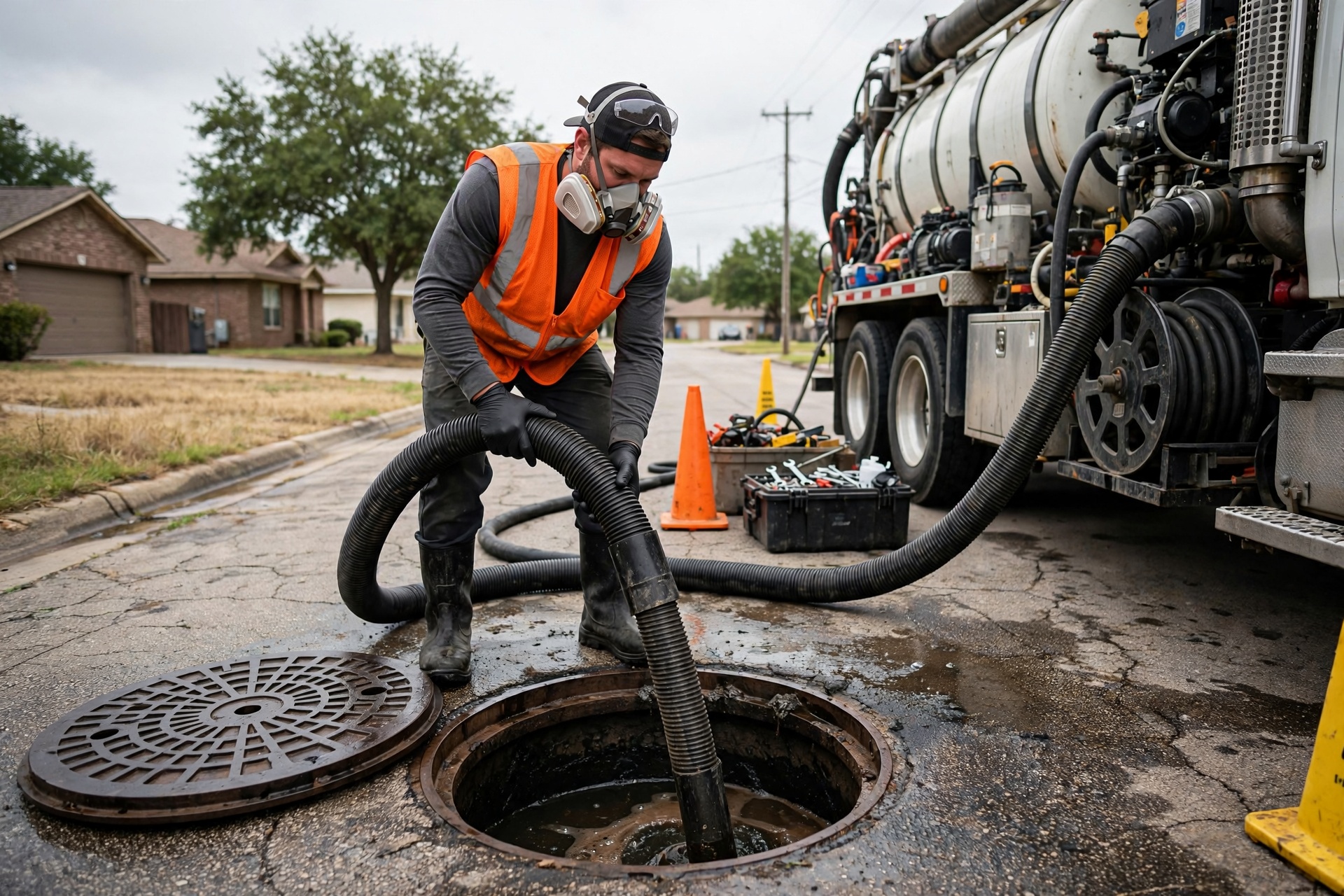
DeSoto's older housing stock in North DeSoto and Downtown neighborhoods often features clay or cast-iron lines installed decades ago that crack under shifting Dallas County soils. When these fail during heavy rains common in the humid subtropical climate, sewage backs up into basements and crawl spaces where high summer humidity slows natural drying and promotes rapid bacterial growth. Extraction crews must first isolate the source, then use truck-mounted vacuums to pull standing waste before it migrates under slabs or into Moseley Park-area drainage ditches that feed local waterways.
Extraction work here differs from drier climates because mild winters keep ground moisture elevated year-round, allowing effluent to travel farther along foundations before crews arrive. Technicians frequently encounter hidden pockets behind finished walls in 1970s-1980s ranch homes near the DeSoto Recreation Center, requiring moisture meters and targeted wall removal rather than simple floor pumping. Failure to address these pockets leaves residual odors that return when temperatures rise again.
Dallas County health rules require documented removal of all contaminated porous materials once sewage contacts drywall or carpet padding. Crews document volumes extracted and disposal manifests to protect homeowners when insurance adjusters visit properties in Cedar Hill or Duncanville spillover zones. The 24/7 response from the shop at 917 N Hampton Rd lets teams reach jobs before secondary damage sets in during overnight storms.
Technician insight
In DeSoto, the thing that catches most people out with sewage extraction and removal is how the humid subtropical air keeps crawl spaces and pier-and-beam voids damp long after the visible water is gone. Older homes near Moseley Park often have clay lines that let waste travel under the slab before we even arrive, so skipping the meter scan always leads to callbacks when summer heat returns.
North DeSoto Crawl Space Backup
A homeowner in North DeSoto reported sewage rising through floor vents after heavy rain. Extraction revealed effluent pooled against piers from a cracked clay line. Crews isolated the main, vacuumed the crawl space, mapped moisture into the subfloor, and removed saturated insulation. The property dried without mold growth once humidity was controlled.
Sewage Extraction and Removal Services We Offer
✓Residential Sewage Extraction
Removes standing sewage from homes in North DeSoto and Downtown using truck-mounted vacuums sized for typical Dallas County slab foundations.
✓Commercial Backup Removal
Extracts high-volume waste from businesses near DeSoto Recreation Center where larger floor drains and grease traps complicate access.
✓Crawl Space Sewage Extraction
Targets low-lying areas common in older DeSoto homes where effluent pools against pier-and-beam supports and evaporates slowly in local humidity.
✓Sewage Contamination Mapping
Uses meters to trace how far waste traveled through walls and under slabs before extraction begins in Dallas County properties.
✓Post-Extraction Sanitization
Applies EPA-registered disinfectants to all contacted surfaces after bulk removal to meet local health expectations.
Sewage Extraction and Removal Cost in DeSoto, TX
| Service | Typical Range | What Affects It |
|---|---|---|
| Residential extraction under 500 sq ft | $650–$1,200 | Higher when waste reaches subfloor or walls in North DeSoto homes |
| Crawl space extraction | $800–$1,600 | Varies with pier access and standing depth |
| Commercial backup removal | $1,400–$3,000 | Driven by square footage and drain complexity |
| Hidden moisture mapping add-on | $250–$450 | Required for slab homes common in Downtown DeSoto |
Pricing confirmed on-site before work begins. Call 24/7 for immediate dispatch.
How it works
- 1
Source Isolation
Locate and stop the backup at the main or cleanout before extraction starts to prevent additional flow into the structure.
- 2
Standing Waste Removal
Deploy vacuum equipment to pull liquid and solids from floors, carpets, and low areas while containing runoff.
- 3
Hidden Moisture Detection
Scan walls, cabinets, and subfloors with meters to find pockets left by DeSoto's humid air and older construction.
- 4
Disposal and Documentation
Transport extracted material to approved Dallas County facilities and provide manifests for insurance or code compliance.
Pricing
Cost depends on volume extracted, access difficulty, and amount of hidden moisture in older DeSoto homes.